Humanities
HUMA 1100 - Introduction to the Humanities
Question # 1
All three of the structures I have selected for this question serve as tombs or shrines to great men throughout the history of Iran. The Tomb of Imamzadeh Ahmad dates all the way back to 1167. In this complex you can find the shrines of two men – Imamzadeh Ahmad and Sjeikh Muammad Taghi. A stone below the window of the first tomb is said to be half of the remains of a Hindu Idol seized from India. The graves are marked by Bakhtiari Lions thought to be from the 18th century. These lions are marked with decorations and inscriptions about the men whose graves they guard. The interior of the two shrines differs greatly, but both have great beauty. That of Imamzedeh Ahmad is more basic, as it was decorated in the mid-twelfth century. Still, the dado tiling and painted medallions have kept their vibrant colors. The tomb of Sjeikh Muammad Taghi was decorated as recently as 1914 C.E., almost 750 years later than that of Imamzadeh Ahmad. The paintings above the tomb are much more lavish and have a rococo influence.
From the 15th century is the Tomb of Shahshahan. This architectural piece is an important shrine from the Timurid time period, which lasted from 1393-1453. At this time in history, 70,000 Isfahanis were slaughtered at the command of Timurlane after they killed the people of his military base. Much like the afore-mentioned tombs, there is a dome erected from the top of the building. There is a great deal of alternating repetition and the use of boundaries to draw attention to the blue and green decorations. The building appears to be made of some light-colored stone, maybe limestone.
The Tomb of Baba Rokn Al-Din dates back to the 17th century. This tomb differs in many ways from the previously mentioned tombs. Atop a five-sided base is a twelve-sided pyramid dome. This dome is angular rather than rounder like the other tombs. The vibrant green, yellow, and blue colors are much like the previously mentioned tombs. This tomb seems to be decorated quite intricately externally and internally, with a great use of colorful tiles.
I was drawn to these particular buildings because, in my travels, I often like to see tombs and churches. Decorating a resting place of a greatly admired person or person of importance is taken seriously by people. Sometimes tombs and shrines are more lavishly decorated than places for the living. So much energy and emotions go into these types of buildings.
Question # 2
Compared to the architecture of Salt Lake City, Islamic architecture has been around a great deal longer. Established in 1847, Salt Lake City has a great deal of diverse architecture that keeps changing. Perhaps the most famous building in Salt Lake is the Latter Day Saints temple which is in the center of the city and is the foundation for the layout of the city. This massive building, finished in 1893, does not resemble any of the buildings I looked at in Isfahan; with its sharp peaks and cathedral style towers, as well as the golden trumpeting idol atop. Since Muslim architects are banned from using graven images, you would never see a carving or statue of a person of worship incorporated in Islamic architecture.
The capitol, another one of the most famous architectural landmarks in Salt Lake City bears more resemblance to the architecture of Isfahan. This colossal building’s rectangular base houses a dome, just like all three Isfahan pieces I examined. The exterior has many columns, but as far as colorful decorations, there are none. Most, if not all capitol buildings in the United States have similar characteristics. Out of the dozen that I looked up, all were rectangular in shape and all but two, Arizona and New York, had a cylindrical dome coming from the center. State capitol buildings represent freedom and statehood and are an important piece of history in each state.
If a foreigner were to look at the architecture of Salt Lake City, I believe they would gain insight into how diverse Utah’s heritage is. Salt Lake architects have borrowed techniques from cultures around the world and many time periods. From the Romanesque and Gothic influences of the Cathedral of the Madeleine to the Great Saltair, whose architect was perhaps influenced by Renaissance Russian architecture. Since Utah is such a young state compared to some of the other countries around the world, it’s only natural to adopt techniques that have been used for centuries. Although, Salt Lake has gotten to a point where their architecture is inspiring others. The work of Moshe Safdie on the Salt Lake public library and others like him have inspired many to think outside the box when it comes to architecture.
The Tomb of Imamzadeh Ahmad
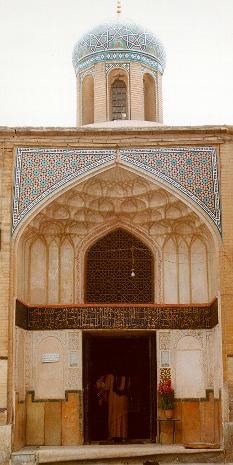
Photo taken from http://www.isfahan.org.uk/ahmad/ahmad.html.
The Tomb of Shahshahan
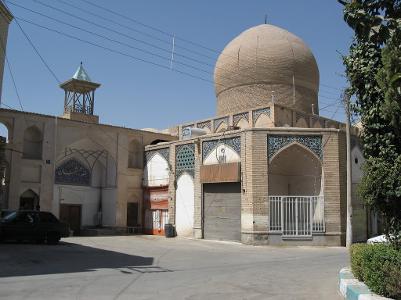
Photo taken from http://www.panoramio.com/photo/59020941.
The Tomb of Baba Rokn Al-Din
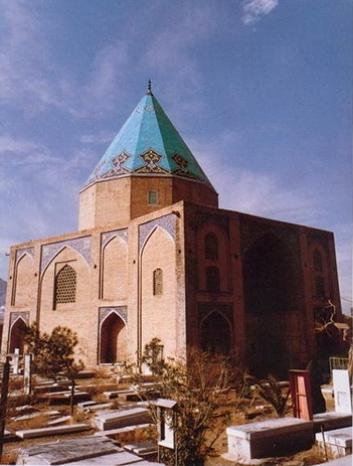
Photo taken from http://isfahan.ir/ShowPage.aspx?page.
